THE INNER CONDITION OF A PUBLIC SPACE
Year 2013
Place: Cusco, (Perù)
Latitude: -13.52436, Longitude: -71.97231
Shared in: https://territoridellacondivisione.wordpress.com/2013/06/25/sharing-new-public-spaces-in-cusco-peru
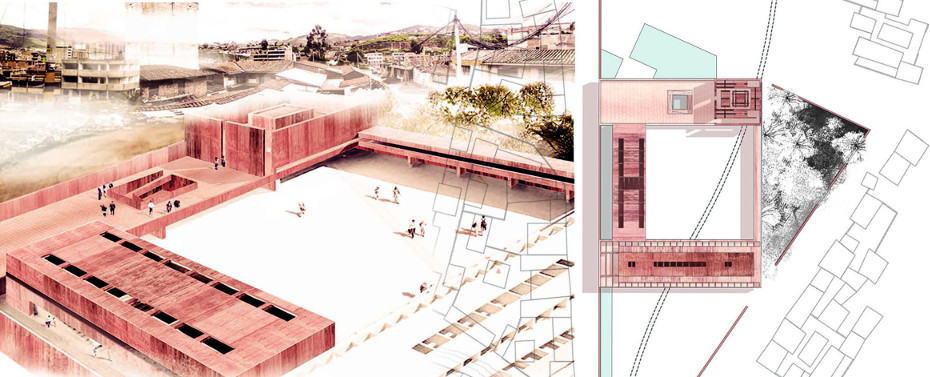
Cusco is a 300,000 inhabitants Peruvian city. It extends for over 10 miles along a narrow valley formed by the Rio Huatanay. The city expands linearly to the east of its incaic historic center without any planning tool that drove growth and densification. A narrow valley, divided longitudinally into two by the runway, with no infrastructure to ensure efficient mobility, with a lack of services and meeting spaces, where each building is rapidly growing up to thirteen floors. On these problems, the project tried to investigate a specific hypothesis: that the conversion in metropolitan tramway of an old railway line that runs along the valley, could give rise to a sequence of small central places, as well as activate a system of linear, fast and efficient public transport. Starting from a complex functional program (including housing and commercial activities, facilities and public services), the project tries to imagine new configurations that could pay particular attention to the mediation between private and collective spaces, local and metropolitan mobility, services to the neighborhood and to the city. The project takes the form of a sequence of strongly identified places within the existing urban fabric. As if it was niches: small and compact closed worlds (often contained by walls) that could provide services to the city. Through this way, these shared spaces may give expression to a variety of different public spaces that could contrast the ongoing process of the historic city’s normalization.
KEYWORDS: City growing, tramway, local and metropolitan mobility, new centrality, services for the neighborhood and for the City